How to Play Mahjong
Trumple plays Hong Kong Old Style Mahjong. There are four players and 144 tiles, flowers included. You take turns drawing a tile and throwing one away, slowly turning your hand into four sets and a pair. To win, your hand also has to be worth at least 3 faan, the points that special features of a hand add up to.
In short: collect four sets and a pair. Draw one, throw one. Take someone’s discard when it finishes a set for you. Win once your hand is complete and worth 3 faan or more.
The Tiles
Three Suits, 1 to 9
There are four of every tile.





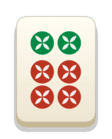
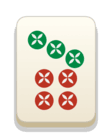

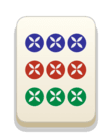
Dots


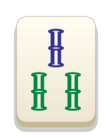
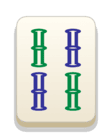
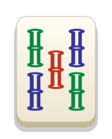
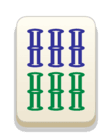
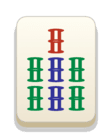

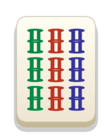
Bamboo
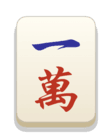
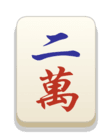
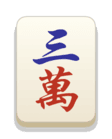
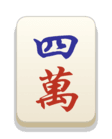
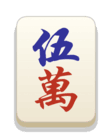
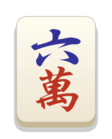
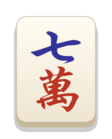


Characters
Honours





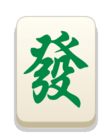

The four winds (East, South, West, North) and three dragons (red, green, white). Honours can’t go in a run, only in groups of the same tile.
Flowers and Seasons
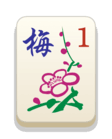
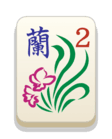
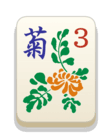
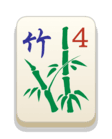
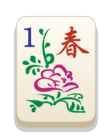
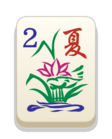
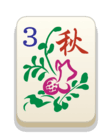
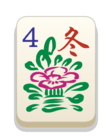
There’s one of each. They never stay in your hand: when you draw one, it goes to the side and you get another tile straight away. They can still earn you faan.
A Winning Hand
Four sets and a pair, 14 tiles in all.
3 in a row, one suit
3 of the same
4 of the same
A kong still counts as one set. Because it uses an extra tile, you draw a replacement when you make one.
Two special hands also win:
- Seven pairs: seven different pairs, all kept in your hand.
- Thirteen orphans: the 1 and the 9 of every suit, one of each wind and dragon, plus a second copy of any one of them.
How a Hand Plays
The Deal
At the start of a game, everyone throws three dice. The highest total becomes East and deals first; if two players tie, they throw again. The dealer then throws three dice to choose where the wall opens: count that many players round the table from the dealer to find the wall, then that many stacks along it. A small red 莊 marker shows who is dealing for the rest of the game.
The dealer sits East and gets 14 tiles. Everyone else gets 13. Turns go East, South, West, North, so the player after you sits on your right.
The last 14 tiles of the wall are never drawn. If the wall gets down to them and nobody has won, the hand is a draw.
Your Turn
- Draw a tile. The app does this for you. The dealer already has 14, so they skip the first draw.
- If that completes your hand and it’s worth 3 faan, you can win. This is called winning self-drawn.
- You can make a kong if you hold four of the same tile, or if you draw the fourth tile for a pung you’ve already laid down. You then draw a replacement tile.
- Discard one tile. That’s the end of your turn.
Claiming a Discard
When someone throws a tile away, you can sometimes take it:
| Claim | Who can | You need |
|---|---|---|
| Win | Anyone | The tile completes a hand worth 3+ faan |
| Pung | Anyone | Two of that tile |
| Kong | Anyone | Three of that tile |
| Chow | Only the player after them | Two tiles that make a run with it |
Chow
There’s no time limit: the game waits until you choose a claim or tap Pass. If more than one player claims the same tile, a win beats a pung or kong, and a pung or kong beats a chow. If two players could win, the one who comes first after the discarder gets it.
A set you claim goes face up in front of you. After a pung or chow you discard straight away, without drawing. After a kong you draw a replacement first.
Robbing the kong: if someone adds a fourth tile to a pung they've laid down, and that tile would finish your hand, you can win with it.
Faan
A winning hand adds up the faan for everything it has. You need at least 3 to win, and a hand can’t score more than 10.
| Hand | Faan |
|---|---|
| Self-drawn (you drew the winning tile) | 1 |
| Concealed hand (you claimed no discards before winning; the winning tile can still be someone’s discard) | 1 |
| Pung of your seat wind | 1 |
| Pung of the round’s wind | 1 |
| Pung of any dragon | 1 each |
| No flowers or seasons | 1 |
| Your own flower or season | 1 each |
| All four flowers, or all four seasons | 2 per set |
| All chows | 1 |
| All pungs | 3 |
| Seven pairs | 4 |
| Mixed one suit (one suit plus honours) | 3 |
| Pure one suit (one suit, no honours) | 7 |
| Mixed terminals (only 1s, 9s, winds and dragons) | 1, on top of all pungs or seven pairs |
| Small three dragons (two dragon pungs + dragon pair) | 5 |
| Small four winds (three wind pungs + wind pair) | 6 |
| Robbing a kong, winning on a kong replacement, or winning on the last tile | 1 each |
| Limit hands: big three dragons, big four winds, thirteen orphans, all honours, all terminals (only 1s and 9s), four kongs, nine gates, heavenly hand, earthly hand | 10 |
Your Seat Wind and Flower
The dealer is East, then South, West and North around the table. Your own flower and season are the ones with your seat’s number: East 1, South 2, West 3, North 4.
1 faan each
Example
Mixed one suit (3) + red dragon pung (1) + no flowers (1) = 5 faan.
Scoring
Your faan turn into a base score:
| Faan | Base |
|---|---|
| 3 | 8 |
| 4 | 16 |
| 5 | 24 |
| 6 | 32 |
| 7 | 48 |
| 8 | 64 |
| 9 | 96 |
| 10 | 128 |
- Winning on a discard: the player who threw it pays twice the base, and the other two pay the base.
- Winning self-drawn: all three pay twice the base.
- A drawn hand: nobody pays.
Whatever one player wins, the others lose, and scores carry over from hand to hand.
Dealer and Rounds
The dealer deals again after winning or after a drawn hand. Otherwise the deal moves to the next seat. Once all four seats have dealt, the round’s wind moves on: East, then South, West and North. A game ends when its last wind round is over (see below).
How Long a Game Lasts
Before you start, you choose:
- East round (the default): play until every seat has dealt once.
- Full game: four wind rounds, East, South, West and North.
There’s no endless option for Mahjong. Because the dealer deals again after a win or a drawn hand, a round can run more than four hands. The highest total at the end wins.
Two Ways to Score
You also choose the rules:
- Old HK (the default): Hong Kong Old Style, everything described on this page.
- Jade: a family’s house rules. You need 4 faan to win instead of 3, and some hands are worth different amounts:
| In Jade | Faan |
|---|---|
| Concealed hand | 0 |
| No flowers, no seasons and no winds or dragons (only bamboo, characters and dots) | 2 |
| No flowers or seasons, but you hold winds or dragons | 0 |
| Your own flower | 1 |
| Anyone else’s flower | 0 |
| Your own season | 2 |
| Anyone else’s season | 1 each |
| All four flowers | your own flower plus 2 |
| All four seasons | 7 in all, enough to win on its own |
| Pung of the red dragon | 2 (green and white stay 1) |
| All chows | 2 |
| Seven pairs | 6 |
| Pure one suit | 6 |
| Your pair is 2s or 8s | 1 |
| Winning on the last tile of the wall | 1 |
| Winning on a single wait: the tile you needed could only finish your pair | 1 |
| Winning on a kong replacement | no bonus |
| Small three dragons, small four winds | not hands: only their pungs count |
| Limit hands | 10, and nothing else adds (an ordinary hand can add up to more, as high as 18) |
| Thirteen orphans | 12 |
A kong scores the same as a pung of that tile. A kong made entirely from your own hand stays face down for everyone else.
In Jade nobody can rob a kong, and points double every few faan: 4 faan is 16, 5 is 32, 6 to 8 is 64, 9 to 11 is 128, 12 to 14 is 256, 15 to 17 is 512 and 18 is 1024. Online, the host picks the rules for the whole table.
Tips for Beginners
- Plan your 3 faan early. A hand of plain runs made from claimed tiles is often worth less than 3. Go for one suit, dragons or winds, or keep your hand concealed.
- Dragons are easy faan. A pung of any dragon is worth 1 for everyone, so hang on to dragon pairs.
- Watch what others pick up. If someone keeps claiming one suit, they’re building a one-suit hand. Late in the hand, stop throwing them that suit.
- Think before you discard. If your tile wins someone the hand, you pay double.
- You can only chow from the player before you. Pungs and kongs can come from anyone.